
 Image 1 of 2
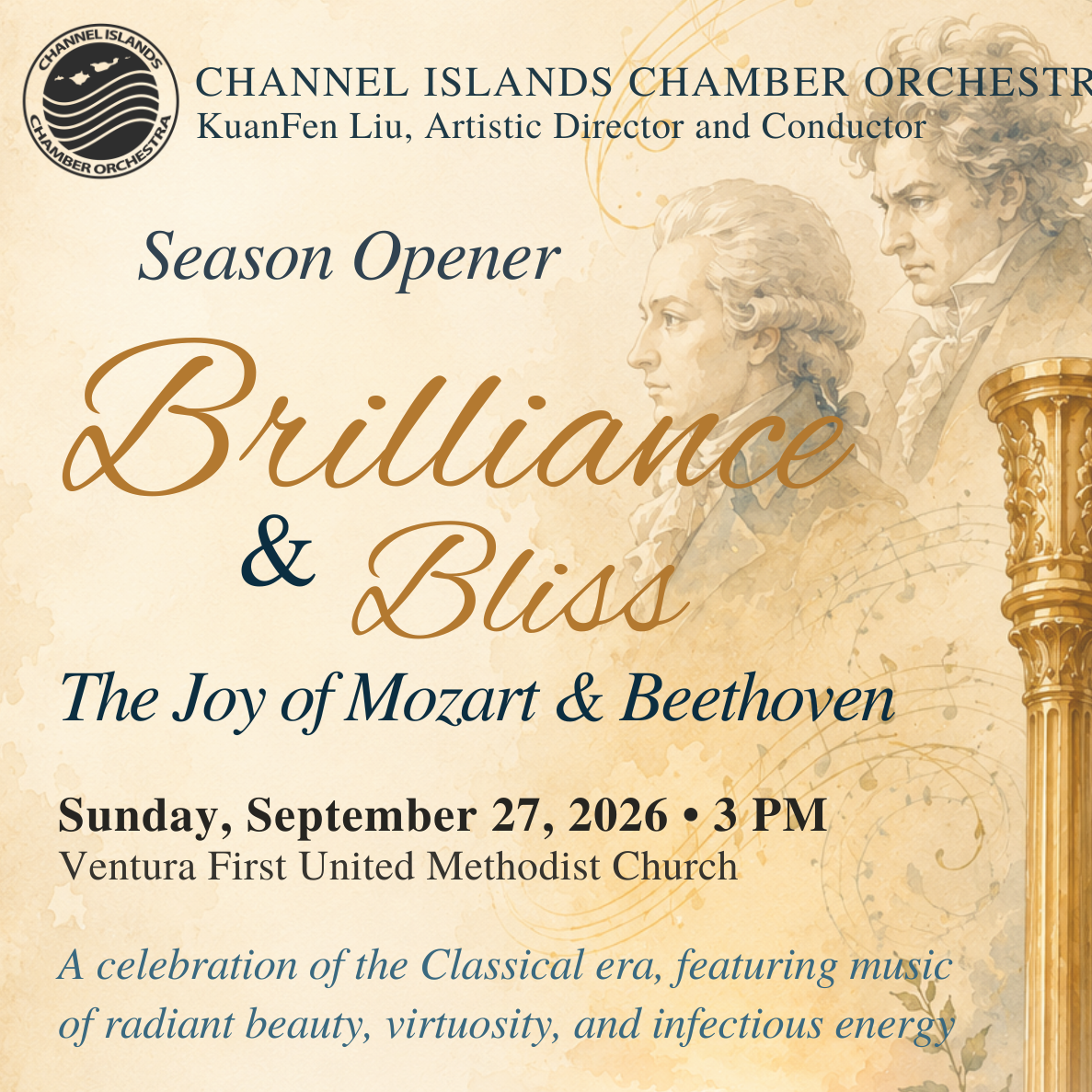 Image 2 of 2
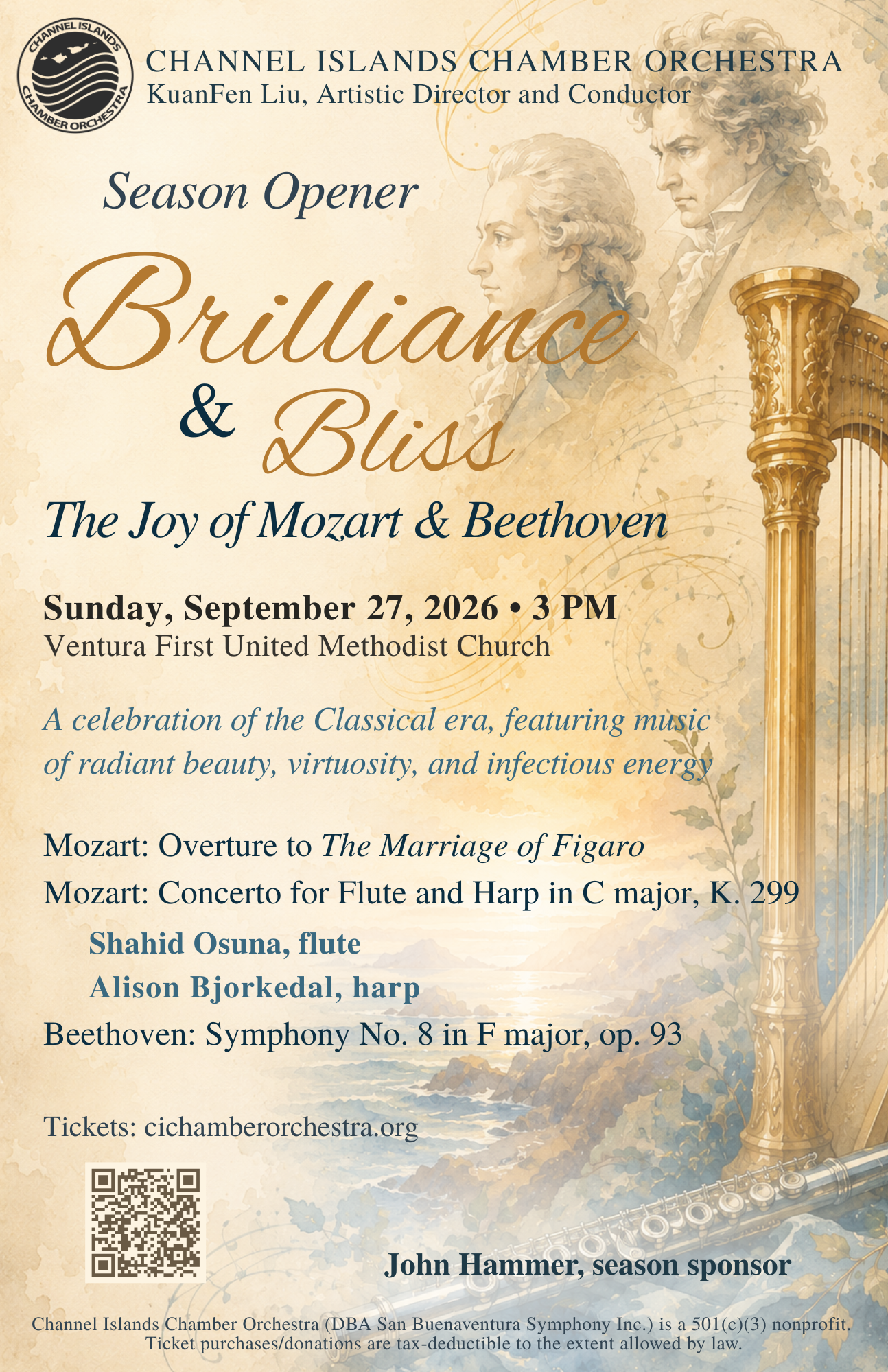
Sunday, September 27, 2026 • 3 PM
Ventura First United Methodist Church
Our soloists:
Wolfgang Amadeus Mozart
Overture to The Marriage of Figaro (1786)
When we think of Mozart’s compositions, many of us recall his symphonies, concertos, sonatas, string quartets, and other instrumental masterpieces. But Mozart considered himself primarily an opera composer. In a letter to his father, he said he believed that opera was the highest form of musical expression. Most of his operas, like this one, are in Italian, as was the custom, if not the requirement, in the 18th century. His opera overtures hold a prominent place in today’s orchestral repertoire. They were intended to be stand-alone orchestral works that set the tone and mood of each opera. Unlike 19th-century opera overtures, they rarely introduced the operas’ melodic themes. Such is the case with this overture. Mozart chose to set the stage for a day in the life of Figaro with a very fast tempo, rapid scales, repeated notes, and sudden contrasts in volume (loud vs. soft). The brevity of the overture, under four minutes, also reflects the one crazy day of Figaro’s wedding.
Wolfgang Amadeus Mozart
Concerto for Flute and Harp (1778)
Having been dismissed by the Prince-Archbishop of Salzburg from his position as concertmaster of the court orchestra, the 22-year-old Mozart went to Paris in 1778 with his mother to seek employment and commissions. There, he met the Duke of Guînes, who hired him to give the Duke’s daughter, Marie, composition lessons. The Duke, an accomplished flute player, commissioned this concerto for himself and his daughter, who played the harp. In three movements, the concerto is lightly scored for strings, oboes, and French horns only. Mozart treats the harp as an equal to the flute—not an accompaniment instrument. The two engage in dialogues with each other as well as with the orchestra. The first movement is in the sonata-allegro form, the second in a three-part song form (ABA), and the third movement is a rondo (ABACABA). In February of this year (2026), researchers discovered the notebook Mozart used in his lessons with Marie. It contains composition exercises and seven short pieces for flute and harp. There are also notes in both Mozart’s and Marie’s hand.
Ludwig van Beethoven
Symphony No. 8 (1812)
The shortest of Beethoven’s symphonies, the Eighth is perhaps his lightest and most humorous. Its retro structure, in the style of Haydn, is deceiving. Filled with surprises, the symphony is replete with sforzandi (sudden “hits,” “jabs,” or “punches”) counterbalanced with delightful, singable melodies. Experimental and unusual in ways, the symphony contains no slow movement. The four movements are: 1. Allegro vivace e con brio (Lively and with spirit), 2. Allegretto scherzando (A little lively and jokingly), 3. Tempo di Menuetto (Minuet tempo), and 4. Allegro vivace (Fast and lively). Structurally, the four movements are: 1. Sonata-allegro, 2. Sonatina (minimal development), 3. Scherzo with trio (ABA), and 4. Sonata-allegro. The fourth movement is particularly amusing, especially the two codas. The first coda leads us to believe the symphony is over, only to be followed another coda with sudden silences and false endings. Finally, it finishes with a big, traditional Beethoven ending.
—Program Notes by Ted Lucas
Sunday, September 27, 2026 • 3 PM
Ventura First United Methodist Church
Our soloists:
Wolfgang Amadeus Mozart
Overture to The Marriage of Figaro (1786)
When we think of Mozart’s compositions, many of us recall his symphonies, concertos, sonatas, string quartets, and other instrumental masterpieces. But Mozart considered himself primarily an opera composer. In a letter to his father, he said he believed that opera was the highest form of musical expression. Most of his operas, like this one, are in Italian, as was the custom, if not the requirement, in the 18th century. His opera overtures hold a prominent place in today’s orchestral repertoire. They were intended to be stand-alone orchestral works that set the tone and mood of each opera. Unlike 19th-century opera overtures, they rarely introduced the operas’ melodic themes. Such is the case with this overture. Mozart chose to set the stage for a day in the life of Figaro with a very fast tempo, rapid scales, repeated notes, and sudden contrasts in volume (loud vs. soft). The brevity of the overture, under four minutes, also reflects the one crazy day of Figaro’s wedding.
Wolfgang Amadeus Mozart
Concerto for Flute and Harp (1778)
Having been dismissed by the Prince-Archbishop of Salzburg from his position as concertmaster of the court orchestra, the 22-year-old Mozart went to Paris in 1778 with his mother to seek employment and commissions. There, he met the Duke of Guînes, who hired him to give the Duke’s daughter, Marie, composition lessons. The Duke, an accomplished flute player, commissioned this concerto for himself and his daughter, who played the harp. In three movements, the concerto is lightly scored for strings, oboes, and French horns only. Mozart treats the harp as an equal to the flute—not an accompaniment instrument. The two engage in dialogues with each other as well as with the orchestra. The first movement is in the sonata-allegro form, the second in a three-part song form (ABA), and the third movement is a rondo (ABACABA). In February of this year (2026), researchers discovered the notebook Mozart used in his lessons with Marie. It contains composition exercises and seven short pieces for flute and harp. There are also notes in both Mozart’s and Marie’s hand.
Ludwig van Beethoven
Symphony No. 8 (1812)
The shortest of Beethoven’s symphonies, the Eighth is perhaps his lightest and most humorous. Its retro structure, in the style of Haydn, is deceiving. Filled with surprises, the symphony is replete with sforzandi (sudden “hits,” “jabs,” or “punches”) counterbalanced with delightful, singable melodies. Experimental and unusual in ways, the symphony contains no slow movement. The four movements are: 1. Allegro vivace e con brio (Lively and with spirit), 2. Allegretto scherzando (A little lively and jokingly), 3. Tempo di Menuetto (Minuet tempo), and 4. Allegro vivace (Fast and lively). Structurally, the four movements are: 1. Sonata-allegro, 2. Sonatina (minimal development), 3. Scherzo with trio (ABA), and 4. Sonata-allegro. The fourth movement is particularly amusing, especially the two codas. The first coda leads us to believe the symphony is over, only to be followed another coda with sudden silences and false endings. Finally, it finishes with a big, traditional Beethoven ending.
—Program Notes by Ted Lucas